
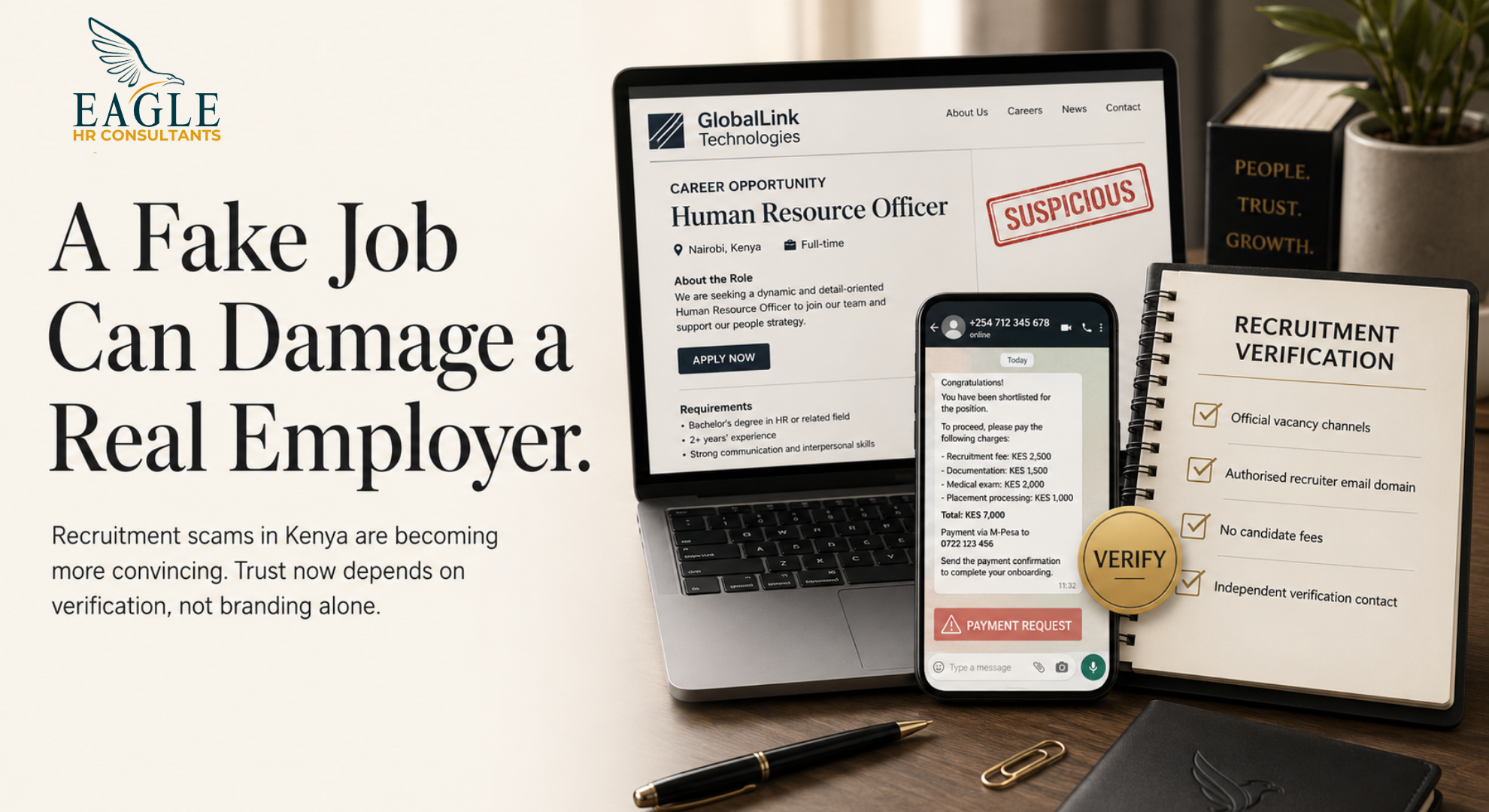
A jobseeker sees a vacancy online: The company name is familiar, the logo looks correct, the role sounds plausible and the person communicating with them appears to know something about the organization. The conversation shifts elsewhere: Money is requested for recruitment, documentation, medical examinations, placement or some other supposed requirement. By the time the applicant realises the opportunity was false, the fraudster may already have their money, identification documents or personal information.
For employers, there is an uncomfortable fact behind that experience: The victim may remember your company’s name more clearly than the name of the person who defrauded them. Recruitment scams therefore create more than financial risk for jobseekers. Where a genuine organisation is impersonated, they can also damage employer trust.
Kenya has a real recruitment-fraud problem
This is not a theoretical risk: In January 2026, the Directorate of Criminal Investigations reported the arrest of four suspects in connection with an alleged fake Teachers Service Commission recruitment scheme involving forged appointment letters and losses exceeding Ksh 40 million. According to the DCI, some victims borrowed money, sold property or exhausted savings while pursuing the promised employment. In July 2026, the DCI reported another alleged employment fraud involving more than Ksh 8.6 million from people promised jobs in government institutions. The methods vary, but the underlying psychology is familiar. Employment carries hope, income and social mobility. A credible opportunity therefore creates emotional urgency. Fraudsters exploit that urgency by making verification feel like an obstacle to an opportunity that might disappear. Modern digital communication makes impersonation easier. Brand material, employee names, previous vacancies and organisational information are often publicly available. International reporting has also documented increasingly sophisticated recruitment scams using copied recruiter identities, social media and AI-assisted personalisation. The appropriate response is not panic, but to have better verification methods.
What employers should publish on every recruitment channel
Every organisation that advertises jobs publicly should have a recruitment-verification standard. At minimum, candidates should be able to establish four facts without difficulty.
1. Where genuine vacancies are published
Your careers page should identify the channels through which your organisation recruits.
If you publish on LinkedIn, your website and selected job boards, say so.
If an advert appears elsewhere, candidates should know where to cross-check it.
2. How genuine recruiters communicate
State the corporate email domain used for recruitment.
Where recruitment agencies are authorised to act for the organisation, candidates should be given a method of confirming that relationship.
3. Whether candidates are ever required to pay
A clear recruitment-fee statement removes ambiguity.
If your organisation never charges candidates for applications, interviews or appointments, write exactly that.
Do not assume everybody knows.
4. Where suspicious recruitment can be verified
Create one verification route.
It may be a corporate email address, careers-page form or telephone contact.
What matters is that the applicant has an independent channel that does not lead back to the person offering the supposed job.
Jobseekers should verify the recruiter, not merely the advert
The National Employment Authority’s NEAIMS platform provides a register showing the status of private employment agencies and includes facilities for checking and reporting agencies.
A professional-looking advert should therefore never be treated as sufficient verification on its own.
Before paying money or providing highly sensitive information, applicants should independently establish who the recruiter represents and whether the opportunity appears on an official channel.
This is especially important where contact moves quickly to WhatsApp or another private messaging platform.
WhatsApp itself is not proof of fraud. Many legitimate organisations use it.
The issue is whether the opportunity can also be independently authenticated.
What should an employer do when its brand is impersonated?
Speed matters; once a false vacancy is identified, the organisation should verify internally that the advert is fraudulent, publish a clear notice on official channels and report the content to the platform on which it appeared. Candidates should be told precisely how genuine recruitment works. Relevant screenshots, messages and account details should be preserved. Where criminal conduct is suspected, the matter should be reported to the appropriate authorities. The DCI currently provides channels through which members of the public can report suspected criminal activity, while the National Employment Authority provides mechanisms relating to fake or unregistered recruitment agencies. The organisation should then review the weakness that made the impersonation believable.
Was the genuine vacancy difficult to verify?
Was there no recruitment notice on the website?
Did the company have several unofficial recruitment contacts?
Was there no public statement about candidate fees?
Fraud prevention is stronger when those questions are answered before an incident rather than after one.
Recruitment trust now requires proof
For many years, employer branding has concentrated on making organisations attractive to candidates. The next discipline is making them verifiable. A logo is no longer enough; even a familiar company name is no longer enough, let alone a professional-looking LinkedIn profile. The employer must create a visible trail through which a candidate can establish that an opportunity is genuine. One practical change can begin immediately: Add a permanent recruitment-verification notice to your careers page and to every vacancy template. It should state where genuine vacancies are published, which communication channels are authorised, whether candidates are ever charged and how suspicious recruitment can be verified.
A genuine employer should never be more difficult to verify than the person pretending to be one. We support organisations in recruitment and executive search, HR advisory, candidate-experience design and recruitment governance. If your organisation needs to strengthen the controls surrounding how vacancies are advertised, verified and managed, speak to our team.